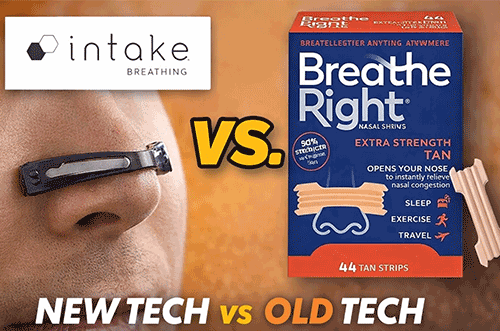
Nasal congestion, snoring, or feeling oxygen-deprived during a workout are persistent issues that degrade the quality of life for millions. For decades, Breathe Right has dominated the market as the affordable, accessible go-to nasal strip.
However, the arrival of Intake Breathing with its magnetic technology has changed the game. With a price point 5-10 times higher than standard strips, does this “newcomer” actually deliver superior performance, or is it just a flashy tech gimmick?
In this article, we are putting these two products head-to-head, comparing everything from their mechanism of action and durability to wearability and long-term cost, helping you find the “Holy Grail” for your nose.
The Contenders: Two Schools of Tech
Breathe Right: The “Plastic Legend”
Breathe Right is the classic nasal strip you can find at any drugstore.
- The Mechanism: It uses two parallel, spring-like plastic bands embedded in an adhesive strip. When applied to the nose, the plastic attempts to straighten back out, physically pulling the nostrils open.
- Key Features: Simple, single-use, effectiveness relies heavily on adhesive strength.
Intake Breathing: The Magnetic Challenger
Intake Breathing approaches the problem with a more engineered, two-part patented system.
- The Mechanism: You apply two small metal-infused adhesive discs (Tabs) to the outside of your nostrils. Then, a rigid U-shaped plastic band with magnetic ends snaps onto these tabs. The magnetic force pulls the nostrils outward.
- Key Features: The band is reusable, the pull force is strong and consistent, independent of the adhesive's elasticity.
The Science: Why Magnets Might Be Better
To understand the difference, we need to talk about the Internal Nasal Valve—the narrowest point in your airway.
- The Breathe Right Issue: The elastic recoil of plastic strips often provides only a moderate opening. When you inhale deeply (especially during intense exercise), negative pressure can still cause the nasal valve to collapse, restricting airflow.
- The Intake Solution: The magnetic attraction creates a rigid, structural frame. It functions similarly to the Cottle Maneuver (when a doctor manually pulls your cheek to open the airway), ensuring the nasal valve stays fully open even under heavy inhalation.
Real-World Experience: How Does It Feel?
Specs are one thing, but how it feels on your face is what matters.
The Installation Feel
- Intake: Bringing the magnetic band close results in a satisfying, sharp “Click” as it snaps into place. You feel your nostrils being pulled taut immediately. The rush of air is dramatic—users often describe it as “flipping a switch.”
- Breathe Right: The sensation is a gentler, more gradual lift.
While Sleeping (Especially Side Sleepers)
- Intake: The rigid band acts like a bumper. When you bury your face in a pillow, the band absorbs the pressure, preventing the nostril from being squashed shut. The tabs stay secure.
- Breathe Right: Friction against the pillow often causes the edges to peel up. It's common to wake up with the strip stuck to your cheek or hair.
Removal
- Intake: The adhesive is incredibly strong (to withstand the magnet). Ripping it off dry can be painful. It requires moisture to remove safely.
- Breathe Right: Easier to peel off, but often leaves a sticky residue on the bridge of the nose.
Head-to-Head Comparison
A. Airflow & Dilation Efficacy
- Breathe Right: Moderate dilation (50-60%). Good for mild congestion.
- Intake Breathing: Maximum dilation (100%). Superior airflow, ideal for deviated septums or athletes.
- Winner: Intake Breathing.
B. Hold & Durability
- Breathe Right: Prone to peeling if you have oily skin or sweat during the night/workout.
- Intake Breathing: Extremely secure thanks to the two-part system (Tabs adhere to the nostril flare where skin is less oily). Withstands HIIT workout sweat.
- Winner: Intake Breathing.
C. Comfort
- Breathe Right: The strip presses down across the bridge of the nose, which can cause soreness or indentations by morning.
- Intake Breathing: The band hovers externally and does not touch the bridge of the nose. Zero bone pressure.
- Winner: Intake Breathing (Especially for sensitive users).
D. Aesthetics
- Breathe Right: Clear versions available; low profile.
- Intake Breathing: Looks bulky and unusual with a plastic bar across the nose.
- Winner: Breathe Right (Fast, discreet).
The Economic Reality (Cost Analysis)
Don't just look at the sticker price; consider the nightly cost.
- Breathe Right:
- Average Price: ~$15 for a box of 30.
- Cost per night: ~$0.50.
- Intake Breathing:
- Upfront Cost (Starter Kit): ~$39.99.
- Operating Cost (Refill Tabs): ~$1.30/night.
- Note: The magnetic band lasts forever, but you must buy new Tabs.
Conclusion: Intake is roughly 2-3 times more expensive to run daily than Breathe Right.
Summary Comparison Table
| Criteria | Intake Breathing | Breathe Right |
|---|---|---|
| Technology | Magnetic | Elastic Recoil |
| Airflow | Maximum (Prevents Valve Collapse) | Moderate |
| Adhesion | Superior (Sweat-resistant) | Average (Peels with oil) |
| Comfort | No bridge pain | Potential bridge pain/marks |
| Daily Cost | High (~$1.30) | Low (~$0.50) |
The Verdict: Which One Should You Choose?
🌟 Choose Breathe Right IF:
- You only have mild, occasional congestion (colds, seasonal allergies).
- You want to keep costs down.
You need something discreet that doesn't look like a piece of medical equipment
🌟 Choose Intake Breathing IF:
- You suffer from chronic congestion, a deviated septum, or find standard strips ineffective.
- You are an athlete looking to maximize VO2 Max.
- You get pain or bruising on your nose bridge from standard strips.
- You have the budget to invest in premium sleep quality.
8. FAQ & Usage Tips
Q: How do I remove Intake tabs without pain? A: This is a common user error. Do not rip them off! Wash your face with warm water or hold a wet washcloth over your nose for 30 seconds to loosen the adhesive, then peel gently from the edges.
Q: Does Intake cure Sleep Apnea? A: No. Both products only assist in opening the nasal airway to reduce snoring caused by congestion. They are not a replacement for a CPAP machine or medical intervention for Obstructive Sleep Apnea (OSA).